
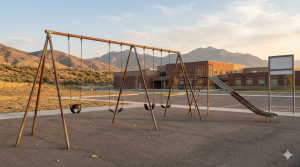
For decades, the story of the South Valley has been one of explosive growth. But on December 9, 2025, that story changed. During a critical budget hearing, officials confirmed that Jordan School District enrollment is declining for the third consecutive year.
With student numbers dropping to approximately 55,819, we are seeing a “hollowing out” of established neighborhoods in the northern part of the district (West Jordan/South Jordan). For homeowners, this creates a new risk: The School Cliff.
In This Scoop:
1. Jordan School District Enrollment: The North vs. South Split
The numbers aren’t shrinking uniformly; the district is bifurcating geographically.
- The North (West Jordan/South Jordan): Older neighborhoods are “aging in place.” Homeowners are staying put, and their children have graduated. This leaves elementary schools operating at 60% capacity.
- The South (Herriman/Olympia): Explosive growth. New families are flooding into high-density housing, causing severe overcrowding and boundary instability.
This creates a fiscal nightmare: The District has to spend millions building new schools in Herriman while paying to heat and light half-empty buildings just a few miles north.
2. Which Neighborhoods are at Risk?
The “Watch List” for potential closure or consolidation is becoming clearer. West Jordan Elementary has been under intense scrutiny due to low enrollment and aging facilities. Proposals have even surfaced to swap the land for high-density housing, a move that has sparked significant community backlash.
Similarly, schools like Joel P. Jensen Middle School face uncertainty as “pocket busing” routes—which bring students from the west to fill seats—are re-evaluated. If those buses stop, enrollment collapses.
Fact Check: You can view the official District summary of the December 9th meeting directly on their website. Read the Jordan District Report.
3. How School Closures Hit Your Equity
Real estate data is clear: Walkability is a premium. When a neighborhood school closes, you lose more than just a convenience; you lose the “Starter Home” buyer pool. Young families specifically target homes within walking distance of elementary schools. If that amenity disappears, demand drops, and so does appreciation.
Furthermore, the “Uncertainty Discount” is real. If buyers hear rumors that a school might close, they often bid lower or avoid the neighborhood entirely to hedge their risk.
4. What Homeowners Should Do Now
If you live in an established neighborhood in South Jordan or West Jordan, stay alert. Watch for “Facilities Study” notices from the District. If you are planning to sell in the next 3-5 years, monitoring these enrollment trends is crucial to timing your exit before a potential elementary school closure announcement.
For buyers, the strategy is to look for “Stability Safe Havens.” While the far South (Herriman/Olympia) offers new homes, it also brings “Boundary Chaos”—where your child’s high school assignment might change every few years due to rapid growth.
In contrast, established High Schools like Bingham and Riverton offer entrenched, stable boundaries. Buying here protects you from the construction dust and constant redistricting battles of the developing south, even if the local elementary schools are quieter.
How Jordan School District Enrollment Impacts Home Values
Don’t guess about how these boundary changes affect your equity. I can provide a detailed valuation that factors in school demand and local market trends.